Culture & Society

Everything about culture, society, sociology and general social sciences. This group is not about lifestyle (fashion, health advices, etc.), political issues, but about general social science. Please keep the subject. All not related posts will be deleted.
‘Human beings are learning machines,’ says philosopher (nature vs. nurture) - http://aminotes.tumblr.com/post...
"The most interesting thing about the human species is our plasticity, our flexibility. (…) Over the past 10 years we have started to see powerful evidence that children might learn language statistically, by unconsciously tabulating patterns in the sentences they hear and using these to generalise to new cases. Children might learn language effortlessly not because they possess innate grammatical rules, but because statistical learning is something we all do incessantly and automatically. The brain is designed to pick up on patterns of all kinds. (...) You only have to stroll down the street to see that human beings are learning machines. (...) if you compare us with other species, our degree of variation is just so extraordinary and so obvious that we know prior to doing any science that human beings are special in this regard, and that a tremendous amount of what we do is as a result of learning. So empiricism should be the default position. The rest is just working out the details of how all this learning takes place. (...)" - Amira
"Philosophy tells us what is possible, and science tells us what is true. Cognitive science has transformed philosophy. At the beginning of the 20th century, philosophers changed their methodology quite dramatically by adopting logic. There has been an equally important revolution in 21st-century philosophy in that philosophers are turning to the empirical sciences and to some extent conducting experimental work themselves to settle old questions. As a philosopher, I hardly go a week without conducting an experiment. My whole working day has changed because of the infusion of science.” - Amira
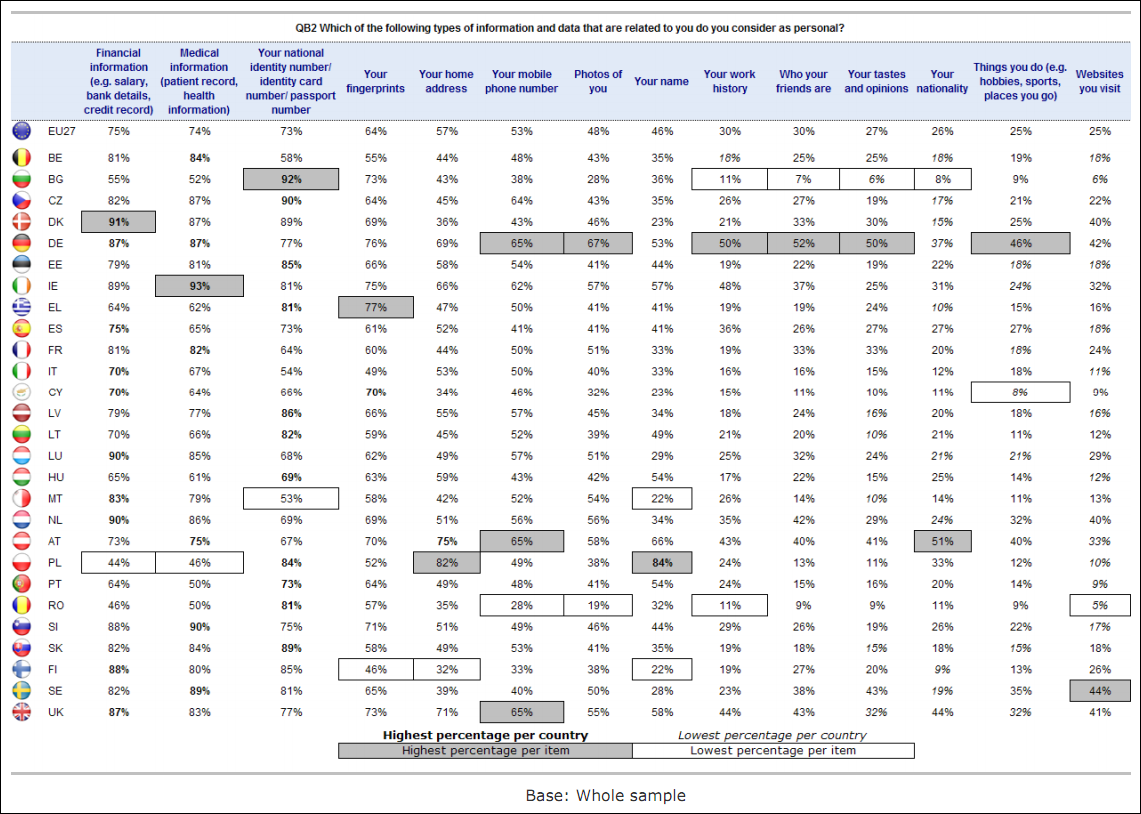
What different Europeans consider 'personal' information - http://www.f-secure.com/weblog...
Icarus, or, the Future of Science by Bertrand Russell (1924) - http://www.marxists.org/referen...
“If men were rational in their conduct, that is to say, if they acted in the way most likely to bring about the ends that they deliberately desire, intelligence would be enough to make the world almost a paradise. In the main, what is in the long run advantageous to one man is also advantageous to another. But men are actuated by passions which distort their view; feeling an impulse to injure others, they persuade themselves that it is to their interest to do so. They will not, therefore, act in the way that is in fact to their own interest unless they are actuated by generous impulses which make them indifferent to their own interest. This is why the heart is as important as the head. By the “heart” I mean, for the moment, the sum-total of kindly impulses. (…) And so we come back to the old dilemma: only kindliness can save the world, and even if we knew how to produce kindliness we should not do so unless we were already kindly. Failing that, it seems that the solution which the Houynhnms adopted towards the Yahoos, namely extermination, is the only one; apparently the Yahoos are bent on applying it to each other.” - Amira
See also: Kevin Kelly - Speculations on the future of science, Edge.com http://www.edge.org/3rd_cul... - Amira
Why Do Languages Die? Urbanization, the state and the rise of nationalism - http://aminotes.tumblr.com/post...
“The history of the world’s languages is largely a story of loss and decline. At around 8000 BC, linguists estimate that upwards of 20,000 languages may have been in existence. Today the number stands at 6,909 and is declining rapidly. (...) The problem with globalization in the latter sense is that it is the result, not a cause, of language decline. (…) It is only when the state adopts a trade language as official and, in a fit of linguistic nationalism, foists it upon its citizens, that trade languages become “killer languages.” (…) The first case of massive language die-off was probably during the Agrarian (Neolithic) Revolution, when humanity first adopted farming, abandoned the nomadic lifestyle, and created permanent settlements. As the size of these communities grew, so did the language they spoke. (...) Permanent settlements changed all this, and soon larger and larger populations could stably speak the same language. (…) What people find useful, they will use. (...)" - Amira
"The state is the only entity capable of reaching into the home and forcibly altering the process of language socialization in an institutionalized way. (...) For the state, the goal is to bind individuals to itself, to an imagined homogeneous community of good citizens, rather than their local community. (...) If [minority nations] do not want to remain politically without influence, then they must adapt their political thinking to that of their environment; they must give up their special national characteristics and their language. (...) This is largely the story of the world’s languages. It is, as we have seen, the history of the state, a story of nationalistic furor, and of assimilation by force." - Amira
“Isn’t language loss a good thing, because fewer languages mean easier communication among the world’s people? Perhaps, but it’s a bad thing in other respects. Languages differ in structure and vocabulary, in how they express causation and feelings and personal responsibility, hence in how they shape our thoughts. There’s no single purpose “best” language; instead, different languages are better suited for different purposes. For instance, it may not have been an accident that Plato and Aristotle wrote in Greek, while Kant wrote in German. The grammatical particles of those two languages, plus their ease in forming compound words, may have helped make them the preeminent languages of western philosophy. Another example, familiar to all of us who studied Latin, is that highly inflected languages (ones in which word endings suffice to indicate sentence structure) can use variations of word order to convey nuances impossible with English. Our English word order is severely constrained by having to serve as the main clue to sentence structure. If English becomes a world language, that won’t be because English was necessarily the best language for diplomacy.” -- Jared Diamond http://amiquote.tumblr.com/post... - Amira
K. David Harrison, When Languages Die. The Extinction of the World’s Languages and the Erosion of Human Knowledge, Oxford University Press, 2007 (pdf) http://www.cs.swarthmore.edu/~meeden...
"It is commonly agreed by linguists and anthropologists that the majority of languages spoken now around the globe will likely disappear within our lifetime. The phenomenon known as language death has started to accelerate as the world has grown smaller. "This extinction of languages, and the knowledge therein, has no parallel in human history. K. David Harrison's book is the first to focus on the essential question, what is lost when a language dies? What forms of knowledge are embedded in a language's structure and vocabulary? And how harmful is it to humanity that such knowledge is lost forever?" http://www.amazon.com/When-La... - Amira
The Power of Networks: Knowledge in an age of infinite interconnectedness by Manuel Lima | RSA - http://www.youtube.com/watch...!
"Manuel Lima, senior UX design lead at Microsoft Bing, explores the power of network visualisation to help navigate our complex modern world." See also: The Story of Networks http://aminotes.tumblr.com/post... - Amira
Europeana ☞ millions of books, paintings, films, museum objects and archival records that have been digitised throughout Europe - http://www.europeana.com/portal...
"It is an authoritative source of information coming from European cultural and scientific institutions." - Amira
Who are we humans? Jason Silva | The Human Project - http://www.youtube.com/watch...
"It's quite subtle. Nearly imperceptible. Not where we might think of looking first: how we see ourselves—our identity—shapes our future as a species. So let's tell a story about ourselves—let's build a cultural identity that moves us to dream bigger, learn faster.... go places, evolve into something even better." #humanbeing #evolution #life #future - Amira
Edward Glaeser: ‘Cities Are Making Us More Human’ http://theeuropean-magazine.com/420-gla...
“As opposed to the conventional wisdom, Harvard economist Edward Glaeser believes urbanization to be a solution to many unanswered problems, such as pollution, depression and a lack of creativity. (…) People who live in urban apartments all typically use less electricity at home and less energy at home heating than people who live in larger suburban or rural homes. A single family detached house uses on average 83% more electricity than urban apartments do within the United States. (…) Q: How are cities making us smarter? Glaeser: I think the most important thing cities do today is to allow the creation of new ideas. Chains of collaborative brilliance have always been responsible for human kind’s greatest hits. We have seen this in cities for millennia – Socrates and Plato bickered on an Athenian street corner. (...) It helps us to know each other, learn from each other and to collectively create something great. In some sense, cities are making us more human. Our greatest asset as a species is the ability to learn from the people around us. (...)" - Amira
"These facts are related to the role cities play today, a role very much tied to the generation of information. Globalization and new technologies did make the industrial city obsolete, at least in the West. But they also increased the idea of returns of human capital and innovation. (...) I also want to emphasize that cities are often places of significant and often positive political change. One thing that those countries need is political change, which is much more likely to come out of an organized urban group than it is to come from a dispersed agricultural population. (…) If you compare countries that are more than 50% urbanized with countries that are less than 50% urbanized, incomes are five times higher in the more urbanized countries and infant mortality rates are less than a third in the more urbanized countries. (…)” http://aminotes.tumblr.com/post... - Amira
Infinite Stupidity. Social evolution may have sculpted us not to be innovators and creators as much as to be copiers | Edge - http://aminotes.tumblr.com/post...
"If we think that humans have evolved as social learners, we might be surprised to find out that being social learners has made us less intelligent than we might like to think we are. And here’s the reason why. (...) I can choose among the best of those ideas, without having to go through the process of innovation myself. So, for example, if I’m trying to make a better spear, I really have no idea how to make that better spear. But if I notice that somebody else in my society has made a very good spear, I can simply copy him without having to understand why. (...) We like to think we’re a highly inventive, innovative species. But social learning means that most of us can make use of what other people do, and not have to invest the time and energy in innovation ourselves. (...) As our societies get larger and larger, there’s no need, in fact, there’s even less of a need for any one of us to be an innovator, whereas there is a great advantage for most of us to be copiers, or followers. (...) If we imagine that there’s some small probability that someone is a creator or an innovator, and the rest of us are followers, we can see that one or two people in a band is enough for the rest of us to copy, and so we can get on fine. And, because social learning is so efficient and so rapid, we don’t need all to be innovators. We can copy the best innovations, and all of us benefit from those. (...) - Amira
Thanks for pointing this book, Ruchira! I still have in mind Malcolm Gladwell's "Outliers" - an interesting study of what determines the "success" and redefines the word "genius" (from a more sociological context). http://www.amazon.com/Outlier... - Amira
Human Communication Dynamics :: Self-Reported Ties and Email Networks - http://www.plosone.org/article...
abstract and paper too verbose... simply: "By examining precisely who had the different response times -- friends, colleagues, or acquaintances -- Uzzi and Wuchty uncovered a more telling pattern: the fastest responses went to friends and that the slowest responses went to acquaintances, with colleagues somewhere in between. Having established this, the researchers could use the response times to predict who was a friend, colleague, or acquaintance without checking the employee survey at all. According to Uzzi, it should be possible to go a step further and rank a person's friends just by peeking at their inbox and outbox and seeing who gets the fastest responses." \\ Duh! - Adriano
How the English Language was Developed. History of English in 10 minutes - http://www.youtube.com/watch...!
"Originally on the British Isles. there were a group of Celtic tribes that lived throughoutBritain. They spoke Celtic languages, which live on as Irish, Scottish Gaelic, Welsh, and Manx. These Celtic-speaking peoples were the original inhabitants of Britain, but then come the English. The Anglo-Saxon invasion wasn't so much an "invasion", as a mass migration over hundreds of years." - Amira
The average number of acquaintances separating any two people in the world is not six but 4.74 | NYTimes.com - http://www.nytimes.com/2011...
"The original “six degrees” finding, published in 1967 by the psychologist Stanley Milgram, was drawn from 296 volunteers who were asked to send a message by postcard, through friends and then friends of friends, to a specific person in a Boston suburb. The new research used a slightly bigger cohort: 721 million Facebook users, more than one-tenth of the world’s population. (...) The experiment took one month. The researchers used a set of algorithms developed at the University of Milan to calculate the average distance between any two people by computing a vast number of sample paths among Facebook users. (...) “It’s the weak ties that make the world small.” (...) - Amira
Lars Backstrom et al. :: FOUR Degrees of Separation (2011) . [Social graphs and Information networks] - http://arxiv.org/abs/1111.4570
"Stanley Milgram in his famous paper challenged people to route postcards to a fixed recipient by passing them only through direct acquaintances. The average length of the path of the postcards layed between 4.6 and 6.1, depending on the sample of people chosen. We report the results of the first world-scale social-network graph-distance computations, using the entire Facebook network of active users (721 million users, 69 billion friendship links). The average distance we observe is 4.74, showing that the world is even smaller than we expected. We study the distance distribution of Facebook and of some interesting geographic subgraphs, looking also at their evolution over time. The networks we are able to explore are almost two orders of magnitude larger than those analysed in the previous literature. We report detailed statistical metadata showing that our measurements (which rely on probabilistic algorithms) are very accurate." Background, https://www.facebook.com/notes... - Adriano
Why Man Creates - animated short documentary discusses the nature of creativity by Saul Bass (1968) http://aminotes.tumblr.com/post... - http://www.youtube.com/watch...
“Why Man Creates is a 1968 animated short documentary film which discusses the nature of creativity. (...) The movie won the Academy Award for Documentary Short Subject. An abbreviated version of it ran on the first-ever broadcast of CBS’ 60 Minutes, on September 24, 1968. Why Man Creates focuses on the creative process and the different approaches taken to that process. It is divided into eight sections: The Edifice, Fooling Around, The Process, Judgment, A Parable, Digression, The Search, and The Mark. In 2002, this film was selected for preservation in the United States National Film Registry by the Library of Congress as being “culturally, historically, or aesthetically significant”." - Amira
Noosphere - the “sphere of human thought” http://en.wikipedia.org/wiki...
"The word is derived from the Greek νοῦς (nous "mind") + σφαῖρα (sphaira "sphere"), in lexical analogy to "atmosphere" and "biosphere". Introduced by Pierre Teilhard de Chardin 1922. (...) In the original theory of Vernadsky, the noosphere is the third in a succession of phases of development of the Earth, after the geosphere (inanimate matter) and the biosphere (biological life). (...) For Teilhard, the noosphere emerges through and is constituted by the interaction of human minds. The noosphere has grown in step with the organization of the human mass in relation to itself as it populates the earth. As mankind organizes itself in more complex social networks, the higher the noosphere will grow in awareness. This concept is an extension of Teilhard's Law of Complexity/Consciousness, the law describing the nature of evolution in the universe. Teilhard argued the noosphere is growing towards an even greater integration and unification, culminating in the Omega Point, which he saw as the goal of history. The goal of history, then, is an apex of thought/consciousness." - Amira
"One of the original aspects of the noosphere concept deals with evolution. Henri Bergson, with his L'évolution créatrice (1907), was one of the first to propose evolution is 'creative' and cannot necessarily be explained solely by Darwinian natural selection. L'évolution créatrice is upheld, according to Bergson, by a constant vital force which animates life and fundamentally connects mind and body, an idea opposing the dualism of René Descartes. In 1923, C. Lloyd Morgan took this work further, elaborating on an 'emergent evolution' which could explain increasing complexity (including the evolution of mind). Morgan found many of the most interesting changes in living things have been largely discontinuous with past evolution, and therefore did not necessarily take place through a gradual process of natural selection. Rather, evolution experiences jumps in complexity (such as the emergence of a self-reflective universe, or noosphere). Finally, the complexification of human cultures, particularly language, facilitated a quickening of evolution in which cultural evolution occurs more rapidly than biological evolution. (...) " - Amira
See also: Richard Doyle - Scaling the Noösphere | TED http://www.youtube.com/watch... - Amira
How Occupy Became This Century’s Free Speech Movement | Wired.com - http://www.wired.com/threatl...
"The Occupy movement took a turn for the symbolic in Berkeley this week, harkening back to a heritage of protest, social unrest, and progressive causes. And, according to one former member of the Free Speech Movement, which began in the same spot, the implications of the Occupy movement could reverberate for a generation — even if the protesters only force small institutional changes. (...) It’s been 47 years since the start of the Free Speech Movement, which inspired the anti-Vietnam War movement, the hippies, and perhaps even the internet as we know it. Free-speech veteran Lee Felsenstein sees parallels in Occupy to the movement he helped start. (...) “The fundamental thing that was going on with the Free Speech Movement was reclaiming public space, and I have seen this expressed recently with the Occupy movement,” Felsenstein said. During 1964, engineering students like him all over the country were not only watching Cal, but working on ways to connect the campuses together using the first nascent and slow computer network. “One of the effects of the Free Speech Movement, and that outbreak of freedom really, was manifested in the development of the internet,” Felsenstein said. “We see the structure of the internet being an open structure, and open structure is what we were fighting for.” (...) - Amira
The Story of Networks. Barabási: From mapping systems to controlling them, Christakis: The hidden influence of social networks [updated] - http://aminotes.tumblr.com/post...
"Barabási updated the Erdős–Rényi model to reflect the existence of hubs in real-world networks. In doing so, he created a tool for scientists to map and explore all manner of complex systems in ways they had never thought to before. (…) “What we have to realize is that control is a natural progression of understanding processes,” he says. “But control is a question of will, and will can be controlled by laws. We have to come together as a society to figure out how far we can push it.” (...) Nicholas Christakis: The hidden influence of social networks. “We’re all embedded in vast social networks of friends, family, co-workers and more. Nicholas Christakis tracks how a wide variety of traits — from happiness to obesity — can spread from person to person, showing how your location in the network might impact your life in ways you don’t even know.” - Amira
"Developments in the theory of complex networks have inspired new applications in the field of neuroscience. Graph analysis has been used in the study of models of neural networks, anatomical connectivity, and functional connectivity based upon fMRI, EEG and MEG. These studies suggest that the human brain can be modelled as a complex network, and may have a small-world structure both at the level of anatomical as well as functional connectivity. This small-world structure is hypothesized to reflect an optimal situation associated with rapid synchronization and information transfer, minimal wiring costs, as well as a balance between local processing and global integration. The topological structure of functional networks is probably restrained by genetic and anatomical factors, but can be modified during tasks." - Amira
Christakis' book is excellent http://www.goodreads.com/book... Barabási's... not so much http://www.goodreads.com/book... - Ken Morley
Thank you Ken, it turns out that Christakis' book is already on my "to-read" list. I've just checked Barabasi's Bursts: “Forget dice rolling or boxes of chocolates as metaphors for life. Think of yourself as a dreaming robot on autopilot, and you'll be much closer to the truth.” - hmm both books seems intriguing... - Amira
"Knowmads and The Next Renaissance" - Edward Harran at TED video - http://edwardharran.com/knowmad...
"Edward Harran shares his personal story into the knowmad movement: an emerging digital generation that has the capacity to work, learn, move and play - with anybody, anytime, and anywhere. In his energetic talk, Edward gives us a compelling insight into his story and highlights what the knowmads represent: the beginnings of the next renaissance." - Amira
A Visual Anthropology of the World's Last Living Nomadic Peoples - http://www.brainpickings.org/index...
"Since the beginning of time, nomadic people have roamed the earth. Looking for food, feeding their cattle. Looking for an existence, freedom. Living in the wild, mountains, deserts, on tundra and ice. With only a thin layer of tent between them and nature. Earth in the 21st century is a crowded place, roads and cities are everywhere. Yet somehow, these people hold on to traditions that go back to the very beginning of human civilization. (...) A decade in the making, this multi-continent journey unfolds in 150 black-and-white and full-color photos that reveal what feels like an alternate reality of a life often harsh, sometimes poetic, devoid of many of our modern luxuries and basic givens, from shiny digital gadgets to a permanent roof over one’s head." - Amira
Michael GAZZANIGA :: Who's in Charge? (2011 book) . [against the epidemic of biologism, and neuro-law] - http://online.wsj.com/article...
"Gazzaniga believes the brain "enables" the mind, but mental activity is not reducible to neural events. While he states that thoughts, perceptions, memories, intentions and the exercise of the will are emergent phenomena, he adds that "calling a property emergent does not explain it or how it came to be." Crucially, the true locus of this activity is not in the isolated brain but "in the group interactions of many brains," which is why "analyzing single brains in isolation cannot illuminate the capacity of responsibility." The community of minds is where our human consciousness is to be found, woven out of the innumerable interactions that our brains make possible. Juries and judges have little idea of the shakiness of the connections between minor abnormalities on brain scans and the commission of a particular crime. Neuro-law is not merely premature; it overlooks the fact that, as Gazzaniga says, "we are people, not brains," and brain scans tell us little about our personhood." - Adriano
Gazzaniga's 2011 master class on Neuroscience and Justice: http://edge.org/convers... 60-min video lecture - Adriano
Saw this last link only now. Thanks :-) - Maitani
Non-Western Philosophy. The Ladder, the Museum, and the Web - http://aminotes.tumblr.com/post...
"The archaeologist studies human material culture on the presumption that, within certain parameters, human beings may be found to do more or less the same sorts of thing wherever they reside and whatever phenotype they may have, and moreover that wherever they are found, human cultures have always been linked in complicated, constitutive ways to other cultures, so that in fact the process of ‘globalization’ is coeval with the earliest out-of-Africa migrations. (…) This is the same web that has always linked the material cultures of at least Eurasia to one another, whatever distinctive regional flavors might also be discerned. (...) When we accept this final point – surely the most heterodox, from the point of view of most philosophers– we are for the first time in a position to study and to teach Indian, Chinese, European, and Arabic philosophy alongside one another in a serious and adequate way." - Amira
"When we accept, for example, that all of the great Axial Age civilizations, to use Karl Jaspers’s helpful label, are the product of a single suite of broad historical changes that swept the Eurasian continent, and thus that Chinese, Indian, and Greek thought-worlds are not aboriginal in any meaningful sense (...), then all of a sudden it becomes possible to study, say, the Buddha and his followers not as an expression of some absolutely other Eastern ‘wisdom’, but instead as a local expression of global developments, or as a node in a web. (…) Philosophy is not supposed to work in the same way as folk beliefs. It is supposed to be a pursuit of culture-independent truth. (...) There are, so to speak, tunnels in the basement between India and Greece, but we’re afraid to go down there. And so the result is that we are not so much liberating philosophy from culture, as we are making each culture’s philosophy irreducibly and incomparably its own, just as if it were a matter of displaying folk costumes in some Soviet ethnographic museum, or in the opening ceremonies of the Olympics. This is unscientific, unrigorous, and unacceptable in any other academic discipline.” - Amira
"The adjacent possible is a kind of shadow future, hovering on the edges of the present state of things, a map of all the ways in which the present can reinvent itself" - http://online.wsj.com/article...
"Ideas are works of bricolage. They are, almost inevitably, networks of other ideas. We take the ideas we’ve inherited or stumbled across, and we jigger them together into some new shape. We like to think of our ideas as a $40,000 incubator, shipped direct from the factory, but in reality they’ve been cobbled together with spare parts that happened to be sitting in the garage. (…) Our bodies are also works of bricolage, old parts strung together to form something radically new. “The tires-to-sandals principle works at all scales and times,” (...) “The adjacent possible.” The phrase captures both the limits and the creative potential of change and innovation. In the case of prebiotic chemistry, the adjacent possible defines all those molecular reactions that were directly achievable in the primordial soup. Sunflowers and mosquitoes and brains exist outside that circle of possibility. The adjacent possible is a kind of shadow future, hovering on the edges of the present state of things, a map of all the ways in which the present can reinvent itself. (...)" - Amira
"Four billion years ago, if you were a carbon atom, there were a few hundred molecular configurations you could stumble into. Today that same carbon atom can help build a sperm whale or a giant redwood or an H1N1 virus, along with every single object on the planet made of plastic. (...) In the movie [Apollo 13], Deke Slayton, head of flight crew operations, tosses a jumbled pile of gear on a conference table: hoses, canisters, stowage bags, duct tape and other assorted gadgets. He holds up the carbon scrubbers. “We gotta find a way to make this fit into a hole for this,” he says, and then points to the spare parts on the table, “using nothing but that.” The space gear on the table defines the adjacent possible for the problem of building a working carbon scrubber on a lunar module. (The device they eventually concocted, dubbed the “mailbox,” performed beautifully.) The canisters and nozzles are like the ammonia and methane molecules of the early Earth, or those Toyota parts heating an incubator: They are the building blocks that create—and limit—the space of possibility for a specific problem. The trick to having good ideas is not to sit around in glorious isolation and try to think big thoughts. The trick is to get more parts on the table.” - Amira
See also: The Kaleidoscopic Discovery Engine. ‘All scientific discoveries are in principle ‘multiples’’ http://ff.im/GkKoJ [updated] - Amira
“‘It is obvious,’ says Hadamard, ‘that invention or discovery, be it in mathematics or anywhere else, takes place by combining ideas. (…) The Latin verb cogito for ‘to think’ etymologically means ‘to shake together.’ St. Augustine had already noticed that and also observed that intelligo means ‘to select among.’ The ‘ripeness’ of a culture for a new synthesis is reflected in the recurrent phenomenon of multiple discovery.” — Arthur Koestler http://www.brainpickings.org/index... - Amira
World Languages Mapped by Twitter | The Atlantic - http://www.theatlanticwire.com/global...
"Twitter is a linguist's dream come true: it compiles millions of messages in hundreds of languages daily, making the question "Who speaks what languages where?" easy to answer. That is the question taken up by self-described "map geek" Eric Fischer. He has created a map of the world's languages used on Twitter by pulling together data collected by Google Chrome. (...) It’s as if someone took one of those composite satellite maps -- you know, impossibly showing the whole world at night, the darkness broken by hubs and strings of artificial light ... and gave it the power of speech." - Amira
Thanks! - Amira
How Epicurus’ ideas survived through Lucretius’ poetry, and led to toleration - http://aminotes.tumblr.com/post...
"Lucretius (borrowing from Democritus and others), says [more than 2,000 years ago] the universe is made of an infinite number of atoms. (...) All things, including the species to which you belong, have evolved over vast stretches of time. The evolution is random, though in the case of living organisms, it involves a principle of natural selection, (...) there is no life after death, and that there is no purpose to creation beyond pleasure. (...) Lucretius argued for a mechanistic universe governed by chance. He also argued for a plurality of worlds (and these planets, like the Earth, need not be spherical) and a non-hierarchical universe. (...)" - Amira
"[It] dropped like an atomic bomb on the fixedly Christian culture of Western Europe. But this poem’s radical and transformative ideas survived (...) One reason is that it was art. (...) In the spirit of commonplace books, readers of that era focused on individual passages rather than larger (and disturbing) meanings. Readers preferred to see the poem as a primer on Latin and Greek grammar, philology, natural history, and Roman culture. (...) “Certainly almost every one of the key principles was an offense to right-thinking Christians,” said Greenblatt. “But the poetry was compellingly, stunningly beautiful.” Its “immensely seductive form, the soul of tolerance — helped to make aesthetics the concept that bridged the gap between the Renaissance and the early modern age." - Amira
Anthropocene: “the recent age of man” [updated]: Anthropocene Cartography - Mapping Human Influence on Planet Earth (video) - http://aminotes.tumblr.com/post...
“This is the age of humans. At least, that’s the argument a number of scientists and scholars are making. They say that the impact of humans on the earth since the early 19th century has been so great, and so irreversible, that it has created a new era similar to the Pleistocene or Holocene. (...) We have been, for the last thousand of years or so, the main geomorphic agent on Earth. It might be hard to believe but, nowadays, human activities shift about ten times as much material on continents’ surface as all geological processes combined. Though our technologies and extensive land-use, we have become a land-shaping force of nature, similar to rivers, rain, wind and glaciers. (...) Mapping the extent of our infrastructures and the energy flows of our activities is, I believe, a good starting point to increase awareness of the peculiarities of the present era. (...)" - Amira
"My goal was to create something new where we could essentially see the main channels through which human exchanges (transport, energy, resources, information) are occurring. Roads and railways are high-impacts human features for obvious reasons. Pipelines and transmission lines are feeding our global civilization, for better or for worse. Submarine cables are physically linking continents together and contributing to this “age of information.” (...) The ecosphere — our world, the Earth. It is quite an old world where many dramatic events took place and where billion of innovations happened through evolution. It is a world fed by our mighty Sun. It is a world where humans appeared only recently. Now, indeed, our species and its 7 billion people is still growing inside it, converting ever more wilderness areas into human-influenced landscapes. This world is however finite, unique and fragile. Now is a good time to start thinking of it this way. I believe we are still, in our heads, living in a pre-Copernician world. It’s time to upgrade our worldview.” - Amira
Noam CHOMSKY :: Speaks to Occupy: If We Want a Chance at a Decent Future, the Movement Here and Around the World Must Grow . [1 Nov 2011 #OWS] - http://www.alternet.org/story...
"In the 1930s one of the most effective actions was a sit-down strike. The reason was very simple: it’s just a step below a takeover of the industry. \ The Occupy movement really is an exciting development. In fact, it's spectacular. It's unprecedented; there's never been anything like it that I can think of. If the bonds and associations that are being established at these remarkable events can be sustained through a long, hard period ahead -- because victories don't come quickly -- this could turn out to be a very significant moment in American history." #OccupyWallStreet - Adriano
And Greece created Europe: the cultural legacy of a nation in crisis | Guardian - http://www.guardian.co.uk/artandd...
"Let us not forget that Europe began in Greece. The idea of the European continent as a cultural unity dates back to ancient Greece in more ways than one.For a start, the Hellenes were the first people to define themselves as "western" as opposed to "eastern". (...) Ancient Greece really was different from the states and cultures that surrounded it, and its achievements defined a specifically European way of seeing the world. Greek literary and artistic forms would shape Europe in a way they did not shape other continents. The nude in art, for example, would be as central to the Renaissance as it was to ancient Athens. Even the mythology of Greece, and its gods, would survive the rise of Christianity to decorate Europe's palaces. Tragic drama would survive and flourish, from Sophocles to Shakespeare.Europeans have rediscovered their Greek legacy again and again, from Marsilio Ficino translating Plato to Picasso confronting the Minotaur. Now that Greece is vilified, its attempt to reassert the democracy that is such a proud creation of ancient Athens is damned as a threat to the eurozone, and a great history of Hellenic Europe is reduced to repeated – and increasingly real – references to an economic "Greek tragedy". What sad times are these." - Amira
I hope you're right ;-) - Amira
Culture and Cognitive Science | Stanford Encyclopedia of Philosophy http://plato.stanford.edu/entries...
"Within Western analytic philosophy, culture has not been a major topic of discussion. It sometimes appears as a topic in the philosophy of social science, and in continental philosophy, there is a long tradition of “Philosophical Anthropology,” which deals with culture to some degree. Within core areas of analytic philosophy, culture has most frequently appeared in discussions of moral relativism, radical translation, and discussions of perceptual plasticity, though little effort has been made to seriously investigate the impact of culture on these domains. Cognitive science has also neglected culture, but in recent years, that has started to change. There has been a sizable intensification of efforts to empirically test the impact of culture on mental processes. This entry surveys ways in which the emerging cognitive science of culture has been informing philosophical debates." 1. What is Culture? 2. Cultural Transmission 2.1 Memes and Cultural Epidemiology 2.2 Imitation and Animal Culture 2.3 Biases in Cultural Transmission 2.4 Bio-cultural Interaction 3. Examples of Cultural Influence 3.1 Language 3.2 Perceiving and Thinking 3.3. Emotions 3.4 Morality 4. Philosophical Intuitions and Culture Bibliography Academic Tools Other Internet Resources Related Entries - Amira
Margaret HEFFERNAN :: Willful Blindness: Why We Ignore the Obvious at Our Peril (2011 book; excerpts) . [on the shortlist for the Financial Times and Goldman Sachs Business Book of the Year Award] - http://www.ritholtz.com/blog...
"A look at some of the more fascinating cognitive failures of the human mind: Denial, Delusion, and Self-Deception. Humans frequently ignore painful or frightening truths, subconsciously believing that denial can protect us. Instead, our delusions make us ever more vulnerable, and whatever suffering we choose to ignore continues unabated. The implications for policy makers, investors, and just about everyone else are enormous." - Adriano
Why do men have a hard time making friends? | Psychology Today - http://www.psychologytoday.com/collect...
"Personal strivings are the central projects that people think about, plan for, and allocate time and energy toward. Strivings provide information about what a person wants as well as the type of person they wish to be. Men disproportionally strive for wealth, success, and power compared to women. Women tend to have a different instruction manual for life, putting a premium on nurturing and befriending other people. This doesn't mean that the average women is unconcerned about success and status, but that this is less likely to be done without checking in on friendships to ensure they attain their highest potential." - Lit
"Using rigorous scientific techniques, we know that strivings matter for well-being. Striving for wealth and power is less likely to bring about happiness and meaning in life than working hard to care for other people and developing intimate bonds." - Lit
The Royal Society, has made its historical journal permanently free to access online - http://www.bbc.co.uk/news...
"The world's oldest scientific academy, the Royal Society, has made its historical journal, which includes about 60,000 scientific papers, permanently free to access online. (...) Its archives offer a fascinating window on the history of scientific progress over the last few centuries. Nestling amongst illustrious papers by Isaac Newton and Charles Darwin are some undiscovered gems from the dawn of the scientific revolution, including gruesome tales of students being struck by lightning and experimental blood transfusions." - Amira
Excellent news! :) - Jenny
TRANSACT ALL THE PHILOSOPHY! - Pete's Got To Go
Archive of All Online Issues 1665-1887 http://rstl.royalsocietypublis... January 1887 - Present http://rstb.royalsocietypublis... - Amira